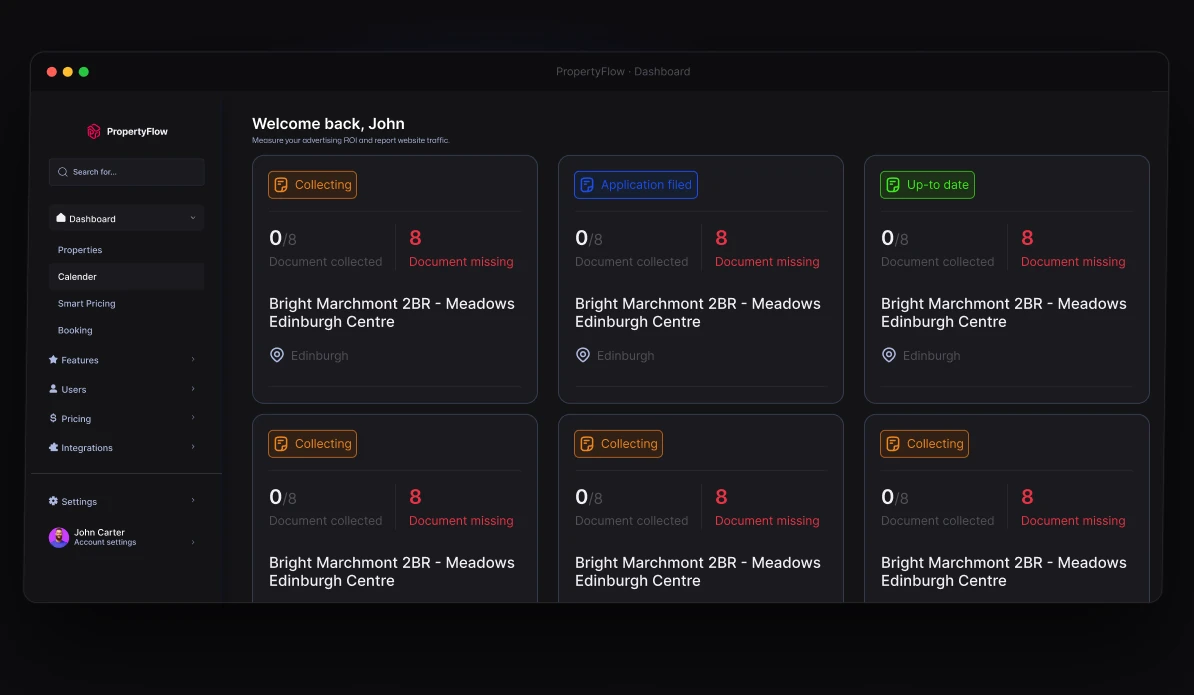
Compliance stays on track Every deadline under control.
As your portfolio grows, compliance gets harder to track manually. PropertyFlow keeps your key documents together and flags upcoming renewals before they become urgent.
every property's compliance documents together
Scotland, England, London & Wales tracked
reminders sent in time to take action
Different markets. Different compliance requirements.
Short-term rental regulations vary across the UK. Explore the key requirements by market below.

Scotland
Short-term let licensing is mandatory
Every short-term let in Scotland must operate under the appropriate licence from its local authority.

Scotland operates a nationwide short-term let licensing scheme covering secondary lets, home sharing and home letting. Each premises generally requires its own licence.
Operators must meet mandatory conditions covering areas including:
- Fire, gas and electrical safety
- Water safety and repair standards
- Maximum occupancy
- Appropriate insurance
- Required information and licence details
- Relevant planning requirements
- Ongoing safety checks and documentation

England
Costs attach to the right payout
Outside London, short-term letting requirements can depend heavily on the property, its use and the local authority.
England does not currently operate the same nationwide short-term-let licensing system as Scotland. Depending on the property and location, operators may need to consider planning, fire and safety obligations, insurance, lease or mortgage restrictions, and other local requirements.
Because requirements can vary, operators should check the position for each property with the relevant local authority.

London
The 90-night rule matters
Entire-home short-term letting in London is generally limited to 90 nights per calendar year without planning permission.
London has specific rules around using residential properties as temporary sleeping accommodation.
Generally, short-term use is permitted for up to 90 nights in a calendar year where the relevant statutory conditions are satisfied. Operating beyond that limit requires planning permission from the local council.
Operators should also check:
- Planning requirements
- Lease or tenancy restrictions
- Mortgage conditions
- Insurance requirements
- Local authority requirements
Rules can therefore differ depending on the property and borough.

Wales
National registration begins October 2026
Visitor accommodation registration opens in October 2026, with providers required to register by 31 March 2027.
Wales is introducing a national visitor-accommodation registration system.
Providers taking bookings for stays of 31 nights or less will generally need to register their accommodation with the Welsh Revenue Authority. Registration applies from individual hosts through to professional operators and includes self-catering accommodation.
Wales is also developing a separate visitor-accommodation licensing framework. The legal default for that licensing scheme to come into force is currently March 2030, subject to further regulations and guidance.
There is also a separate Visitor Levy framework, which individual councils can choose to introduce from April 2027 at the earliest.
*Compliance requirements vary by location and may change over time. PropertyFlow supports compliance tracking and organisation; it does not replace professional or regulatory advice.
The paperwork every UK let keeps on file, in one folder.
Track essential property certificates, safety records, licences and renewal dates in one place, with a clear view of what's current and what's coming up.

Gas safety
Annual checks, where gas safety duties apply
Gas appliances and flues covered by landlord gas-safety duties require an annual safety check by a Gas Safe registered engineer. HSE also requires records of those checks to be kept.

EICR
EICR and electrical inspection records
In Scotland's short-term-let licensing framework, electrical fittings used by guests must be shown to be safe through an EICR; Scottish guidance commonly uses a five-year inspection cycle. England's five-year EICR rules apply to specified rented-sector tenancies.

Fire risk assessment
Recorded and reviewed as required
For paying guest accommodation in England, the Fire Safety Order requires a suitable and sufficient fire-risk assessment, with findings recorded and reviewed regularly; government guidance says an annual review is usually appropriate, as well as after significant changes or incidents. Wales has separate fire-safety guidance for guest accommodation.

Smoke & CO alarm
Safety requirement tracked by property
Scotland's short-term-let licensing guidance explicitly requires adequate fire-prevention steps including working smoke and carbon-monoxide alarms. Requirements elsewhere vary depending on jurisdiction and circumstances.

EPC
Tracked where an EPC is required
An EPC is not automatically required for every holiday let. For example, official Welsh local-authority guidance says furnished holiday lets require an EPC only when particular conditions are met, including letting for four months or more in a 12-month period and the occupier being responsible for energy costs. EPCs can remain valid for up to ten years.
Licence & Registration
Requirement tracked by location
Scotland already has mandatory short-term-let licensing, while Wales is introducing a visitor-accommodation registration and licensing framework. Local planning and licensing rules can also differ significantly.
Set it up once. It runs quietly after that.
Spend less time pulling numbers together and more time understanding them.
See revenue, occupancy and booking performance in one place, with the numbers updating as your portfolio moves.
01
Add your documents
Upload each licence and certificate against the property it belongs to everything lives in one folder, not scattered across email and photos.
02
Set the renewal date
Every document gets an expiry date held against the property, so PropertyFlow always knows exactly what's coming due and when.
03
Get reminded early
Reminders land well ahead of the deadline enough time to book an inspector or rebook a certificate, not a last-minute panic.
UK regulatory regimes tracked in one place
per property, no more scattered PDFs
surprise expiries once a reminder is set
Stay let-ready.
Whatever the rules do next.
Document reminders are included on every PropertyFlow plan. Free for your first three properties. No credit card required.